

Solar economics have quietly rewritten how plants are built. To drive down the levelized cost of energy, developers now oversize PV arrays well beyond inverter capacity. DC-to-AC ratios of 1.25:1 to 1.5:1 are routine on utility-scale projects. The upside is more energy harvested across more hours of the day. The catch is clipping: whenever the array produces more DC power than the inverters can convert, that surplus is simply thrown away. On a large array, the energy lost to clipping can run into the hundreds of thousands of kilowatt-hours every year.
DC-integrated storage is the architecture built to stop that waste. By placing batteries on the DC bus, behind the same inverters as the PV array through DC-DC converters, a DC-coupled plant can capture clipped solar instead of losing it, convert energy fewer times, and share balance-of-system equipment that an AC-coupled design would otherwise have to duplicate.
But here is what the single-line diagram does not show: in a DC-coupled plant, the battery and the solar array share the same inverters. They are no longer two independent systems that can be dispatched separately. Every export setpoint, every charge decision, and every reactive-power command now has to be arbitrated across shared hardware, in real time, within the limits of the batteries, converters, inverters, and the point of interconnection.
The hardware sets the ceiling on what a DC-coupled plant can earn. The control layer decides how much of that ceiling you actually reach.
That control layer is REX™.
DC-coupled solar-plus-storage has moved from niche to mainstream for new-build projects, and the reasons are structural, not promotional:
None of this makes DC-coupling universally better than AC-coupling. AC designs still suit retrofits, standalone storage, and projects that prioritize modular expansion. But for greenfield solar-plus-storage with high DC-to-AC ratios and an energy-arbitrage revenue model, DC integration captures value that an AC-coupled plant structurally cannot.
The same architecture that creates the upside also creates the complexity. In an AC-coupled plant, the PV inverters and the storage PCS are separate, and each can be commanded on its own. In a DC-coupled plant, they are fused behind shared inverters — and that changes the control problem entirely.
At any given instant, the controller has to answer questions like:
These decisions cannot be made in isolation, and they cannot be made slowly. They have to be reconciled continuously against live device feedback, which is precisely what a purpose-built control platform is for.
REX™ transforms DC-coupled solar-plus-storage from connected equipment into a coordinated, revenue-ready asset. Built by Acelerex, it unifies EMS, SCADA, PPC, Block Controller (BC), and DAS into a single intelligent control platform that manages PV inverters, DC-DC converters, batteries, BMS, meters, and protection devices in real time.
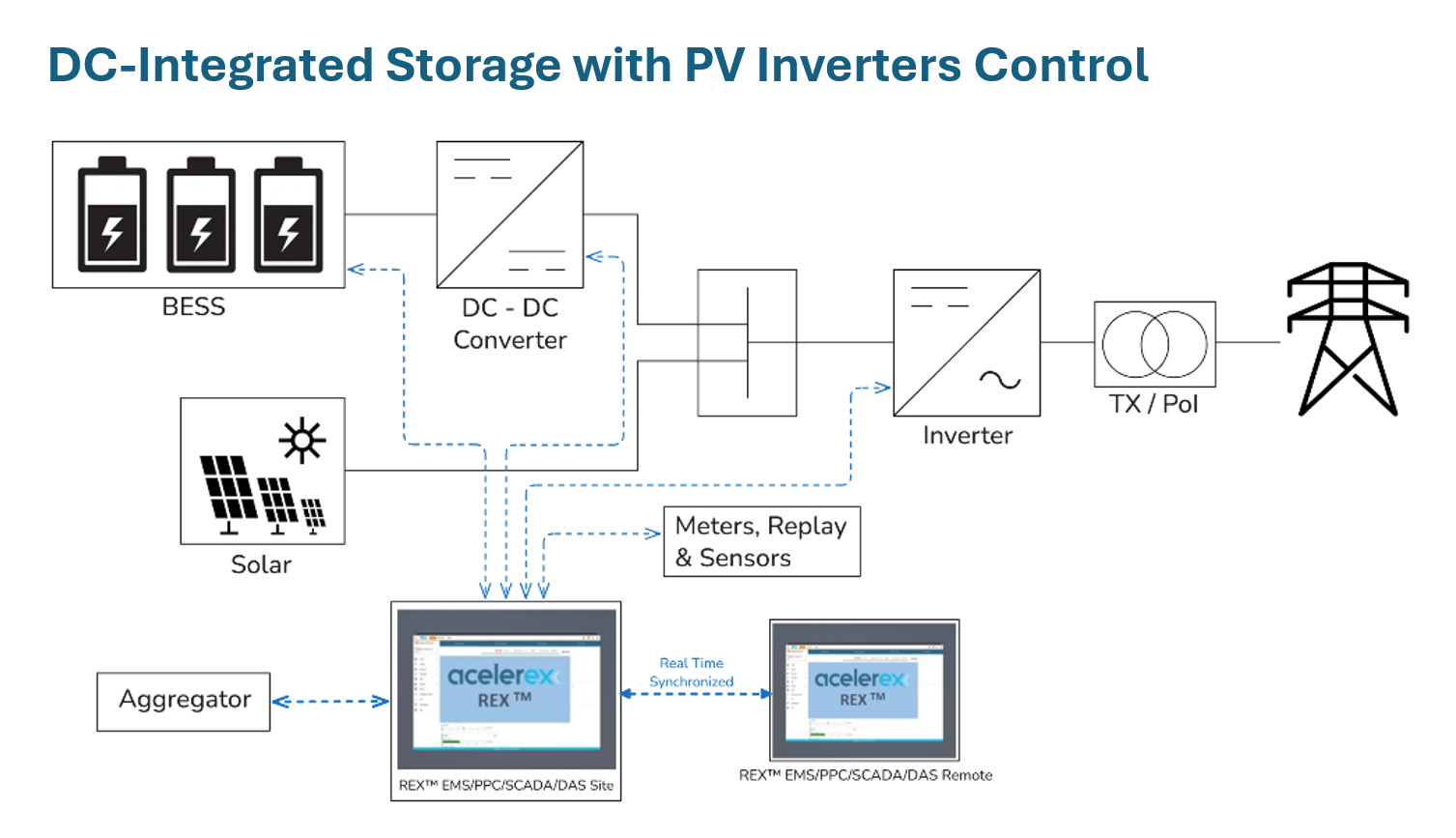
In grid-connected operation, REX™ prioritizes safe execution of every site command. The controller continuously reconciles external setpoints with real-time PV output, battery state of charge, charge/discharge current limits, converter availability, inverter ratings, POI meter feedback, and active alarms. When a command cannot be met, REX™ automatically limits the response to the maximum safe and available capability — rather than failing, tripping, or violating a constraint.
Different projects, and different hours of the same day, call for different behavior. REX™ ships with a library of preconfigured control modes so operators can move seamlessly between firm export, solar-priority charging, SoC management, and direct battery dispatch as objectives and site conditions change.
The practical effect: the same plant can run firm-export compliance during operations, switch to clipped-energy capture as the array ramps past the inverter limit, and pre-position its SoC for the next morning's market — all without re-engineering the control logic.
Capturing value is only worthwhile if the plant stays safe and available. REX™ validates device readiness, equipment limits, communications health, and fault conditions before it executes any site command.
Beyond real-time control, REX™ unifies monitoring, diagnostics, reporting, and cloud connectivity for DC-coupled PV + BESS operations:
It all runs on the REX™ Appliance, rugged, wide-temperature industrial-computer or server hardware with hot-failover for high-availability sites.
DC-integrated storage is one of the most effective ways to raise both the yield and the economics of a solar project, but only when the plant is operated as a single, coordinated asset rather than a collection of devices behind shared inverters. The architecture creates the opportunity; the control layer realizes it.
REX™ gives owners and operators that control layer: real-time coordination of PV, converters, and storage; preconfigured modes for every operating objective; interlocks that keep the plant safe and available; and the visibility to prove performance across the full asset lifecycle. The result is exactly what the technology promises and the market increasingly demands: clipped solar turned into dispatchable energy, and connected equipment turned into a revenue-ready asset.
Ready to see REX™ control your DC-coupled plant? Contact our team to talk through your site architecture and request a demo.