
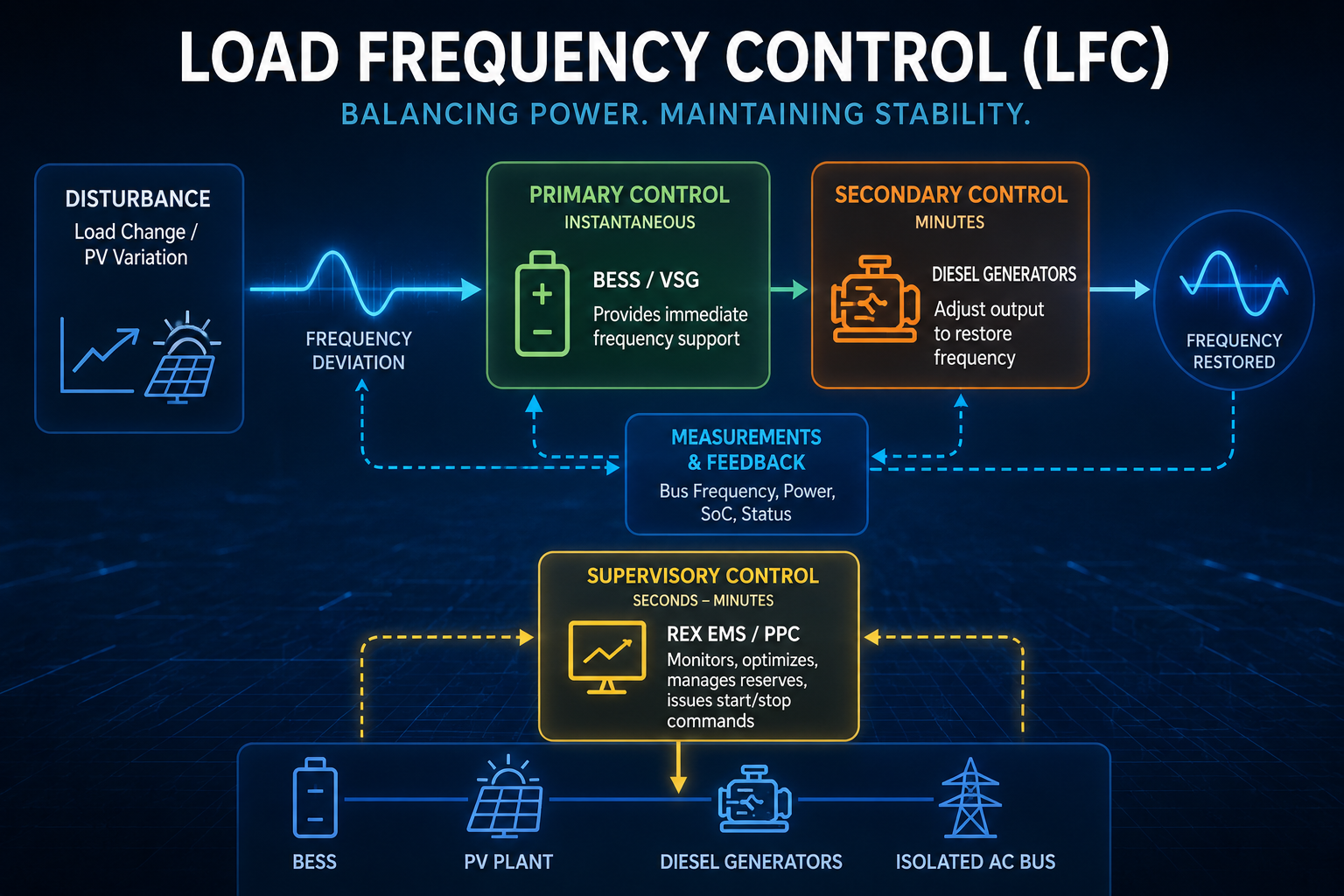
Island utilities across the Caribbean, Pacific, and Indian Ocean have run their grids on diesel and heavy fuel oil (HFO) for decades. Adding solar PV and battery storage can seem straightforward: Replace expensive fuel with free sunlight, charge the battery when the sun is out, and discharge it when demand is high. But as soon as variable generation is added to an island grid, maintaining frequency stability becomes far more challenging.
This blog explains what Load Frequency Control (LFC) is, why it is a challenge for island utilities integrating solar PV and batteries into an existing diesel or HFO fleet.
In a stable grid, generation and consumption are perfectly balanced, so frequency remains at its nominal value: 50 Hz or 60 Hz. When a load suddenly switches on, a cloud passes over the solar array, or a generator trips, the balance is disturbed and frequency begins to drift. On a large interconnected grid with thousands of generators, small imbalances are absorbed by the rotating mass of synchronous machines. On an island grid, the system is smaller and has fewer generators, so disturbances can change frequency quickly; if corrective action doesn’t happen within seconds, the grid can collapse.
Load Frequency Control is the continuous process of matching generation to load so frequency stays within an acceptable band. It is an operational objective every island grid must meet at all times.
In the traditional diesel-only island grid, the diesel governor responds to frequency drops by increasing fuel injection and ramping up power output. It isn’t fast, but it is reliable and on a grid where all generation is dispatchable diesel, it works well. Solar PV changes the equation as PV output isn’t controllable in the same way as diesel. A cloud passing over the array can remove hundreds of kilowatts of generation in just a few seconds, and the diesel governor cannot respond that quickly.
The battery energy storage system (BESS) is the answer to that problem.
Most people think of a battery as something that charges when there is surplus energy and discharges when there is a shortfall. That’s true, but in an island-grid context, the BESS plays a more fundamental role: It becomes the grid-forming source. In other words, the BESS inverter sets and maintains the voltage and frequency reference on the islanded AC bus, not the diesel governor.
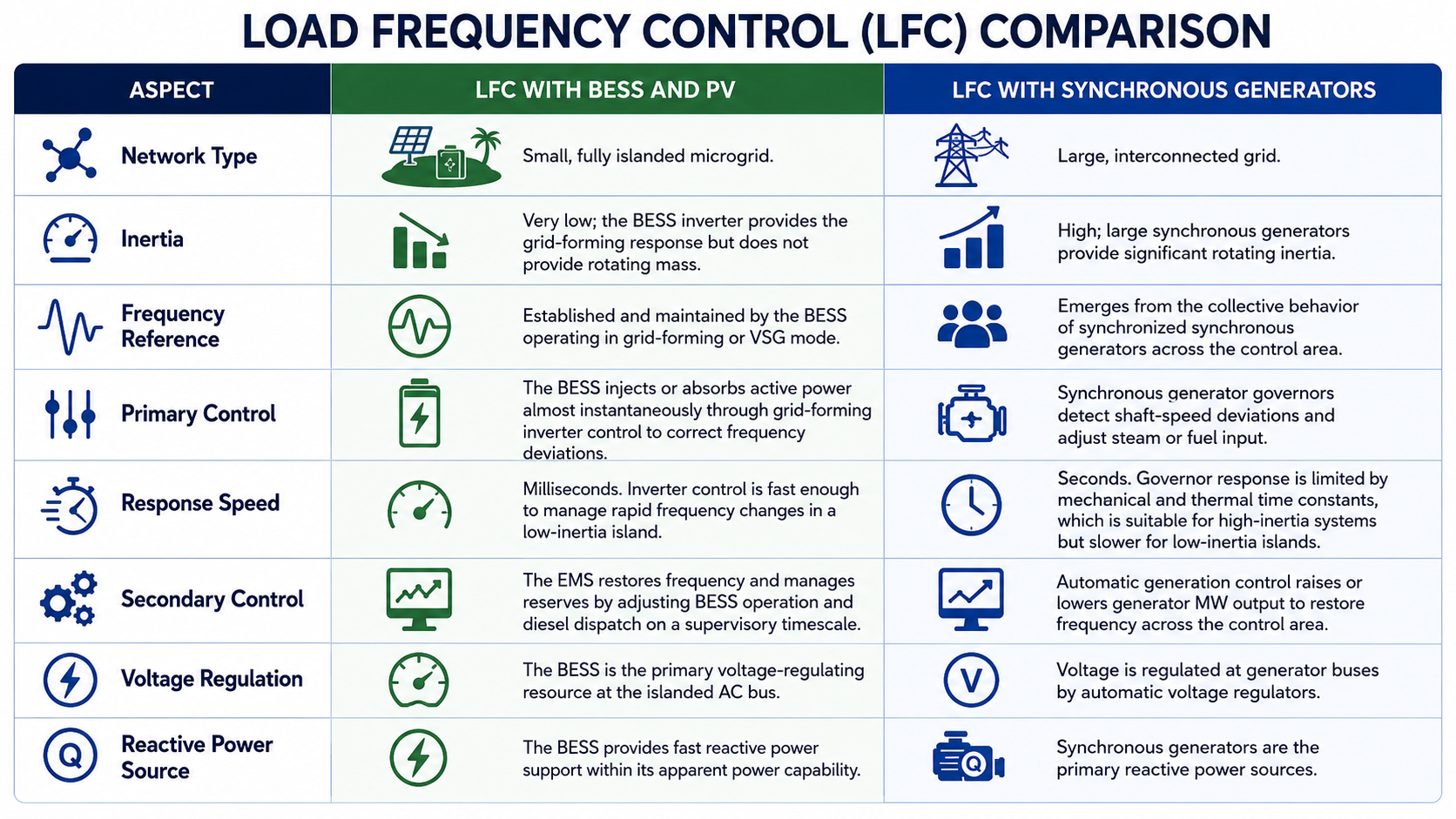
When a BESS operates in grid-forming mode, diesel generators operate in grid-following mode, synchronizing to the voltage and frequency the BESS establishes and following dispatch setpoints issued by the supervisory controller. It matters because the BESS can respond to frequency deviations in milliseconds, while a diesel governor responds in seconds. When a cloud wipes out 1 MW of PV generation in seconds, BESS responds to frequency deviation very quickly.
In a hybrid microgrid with solar PV, BESS, and diesel generators, LFC is implemented through a two-layer control hierarchy. Each layer operates on a different timescale and manages a different aspect of frequency control.
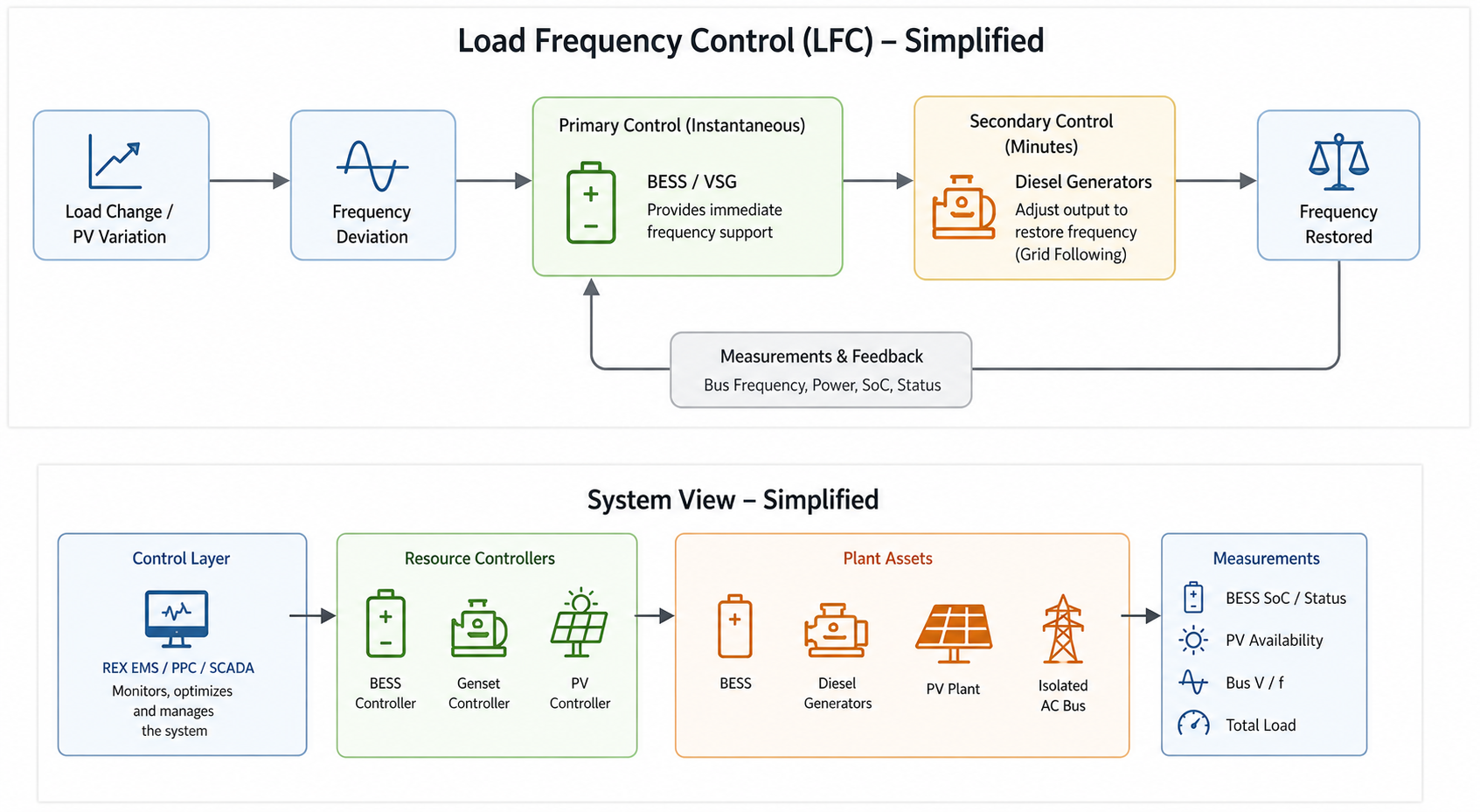
Simplified Functional Control
When load changes or PV output drops, BESS grid-forming inverter responds immediately, automatically, and without waiting for any command from the supervisory controller. The inverter’s VSG control detects frequency deviation at AC bus and adjusts BESS active power output to restore balance. No operator action is needed, and no setpoint is sent. BESS detects the frequency drift and compensates instantly.
EMS/PPC continuously monitors the broader context: What is the BESS state of charge? Is the available reserve enough to handle the next disturbance? Should a diesel generator be started? Does PV output need to be curtailed?
EMS/PPC performs automatic generation control (AGC): It calculates corrective setpoints and sends them to the block controllers for BESS, diesel generators, and PV plant to restore system balance over a minutes-timescale and manage energy reserves.
Following sections explains how LFC is implemented across each operating condition.
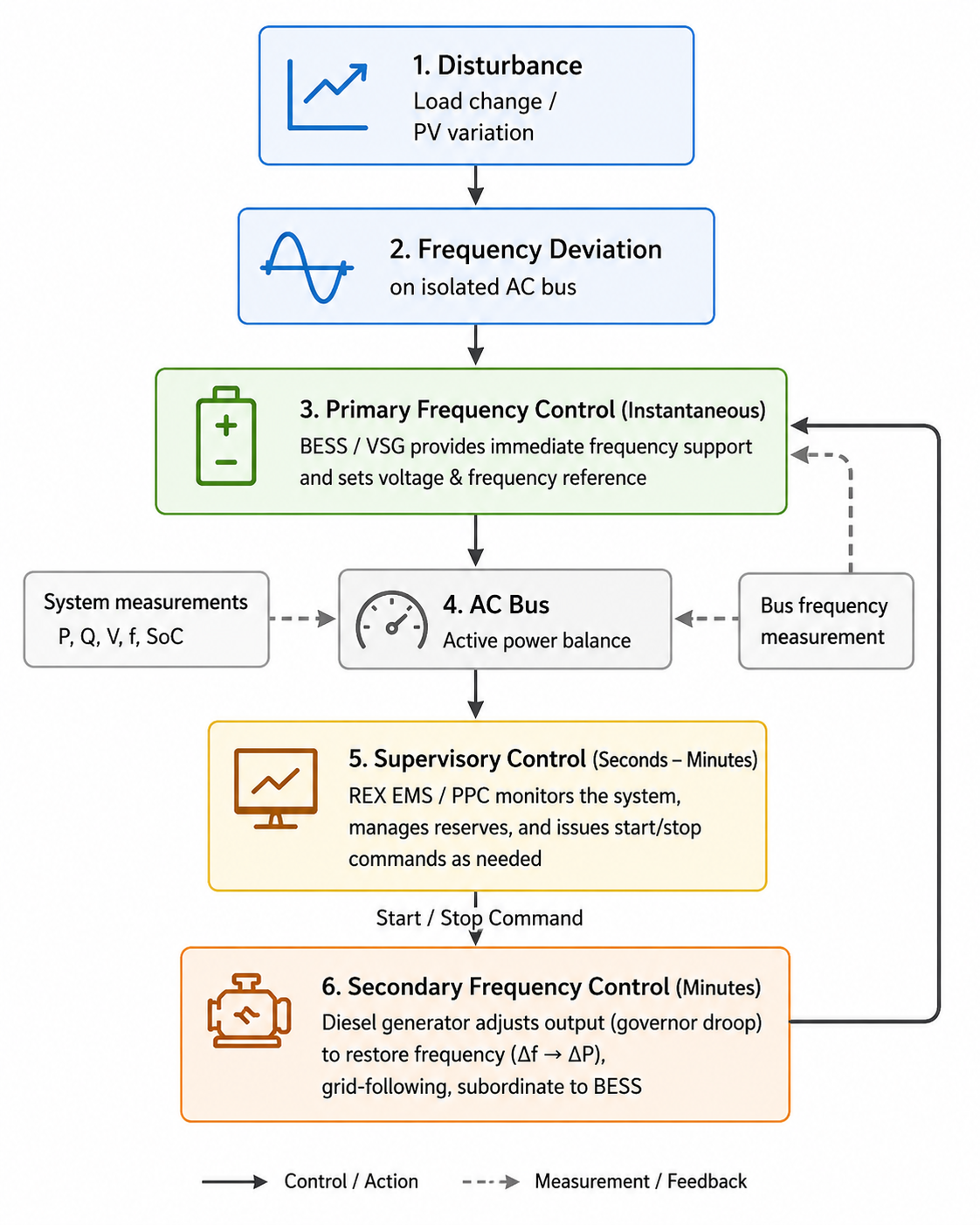
Load Frequency Control Flow
Under normal daytime conditions, when BESS state of charge is between 25% and 99% and PV is generating at or near available output, the system operates without any diesel generators running. BESS maintains the grid-forming role. PV injects whatever the sun provides, and BESS absorbs or compensates for the difference between PV output and load demand in real time. Cloud transients, load switches all are handled instantly by the BESS. EMS monitors continuously but does not need to intervene for every small disturbance.
When BESS state of charge drops below the configured Start SoC threshold (25%), EMS automatically initiates a diesel generator start sequence. It does not wait for an operator to notice a low-SoC alarm and decide what to do. The genset block controller executes the start, synchronizes the generator to the BESS-established grid, and ramps it to the active power setpoint issued by the EMS. Importantly, BESS remains the grid-forming source and diesel provides additional power support. EMS coordinates load sharing between the BESS and diesel so BESS always retains enough headroom to respond to the next disturbance. Once the BESS state of charge recovers to the Stop SoC threshold (60%), EMS issues a controlled genset unload and stop command. Fuel consumption stops, and the system returns to pure BESS and PV operation.
When the BESS is fully charged and PV generation exceeds load demand, BESS cannot absorb any more energy. If left unchecked, the excess generation would over-frequency the grid. EMS/PPC automatically sends a curtailment command to the PV block controller, which progressively reduces PV output . As BESS absorption capacity is restored for example, as load increases or as the battery discharges slightly curtailment is released incrementally.The system automatically manages the surplus, protects the battery, and maintains frequency stability.
REX™ unifies EMS, SCADA, PPC, Block Controller, and DAS into a single intelligent platform. For island-grid LFC:
Digital Twin built into REX™ allows these control behaviors to be tested and validated before deployment on the live plant. Every scenario like cloud transient, low-SoC diesel start, high-SoC PV curtailment, black start from a dead bus can be simulated and confirmed to behave correctly.
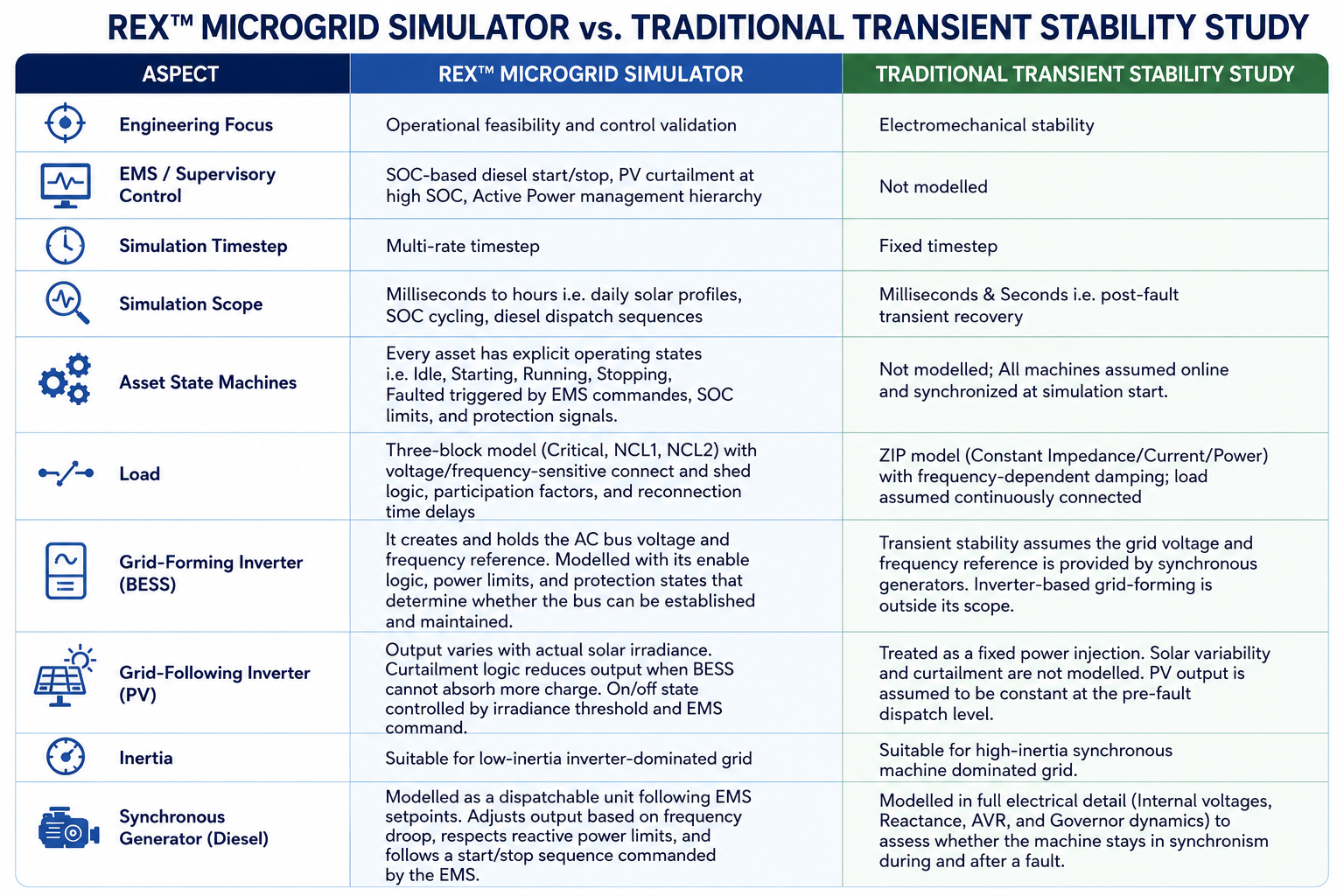
The above chart reveals the differences between the REX Microgrid Simulator and the Traditional Transient Stability simulator.