
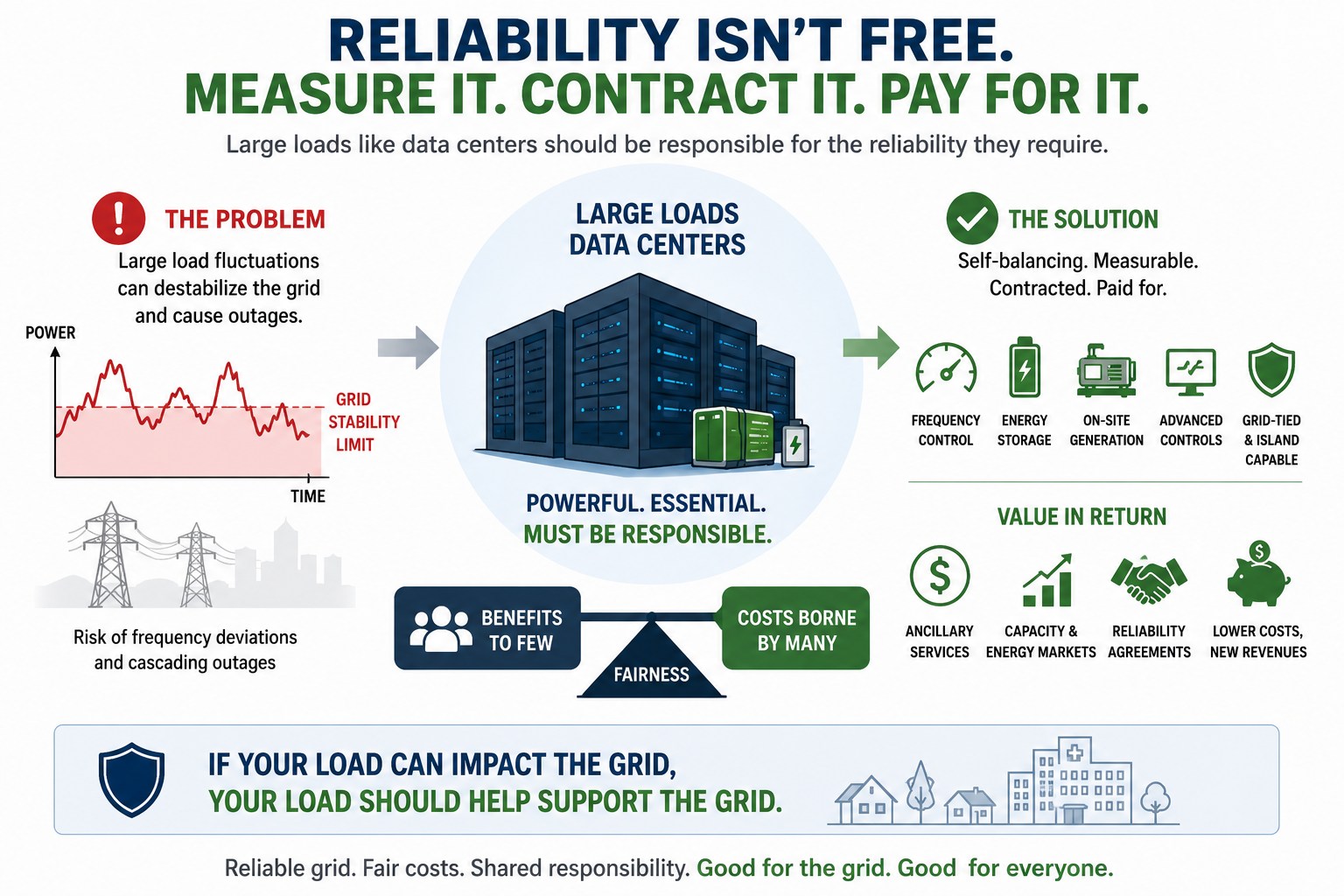
Trillion Dollar Question "Who pays for the reliability of data centers?"
America's electric grid is entering a new era. Massive data centers, AI training facilities, cryptocurrency operations, and other large electrical loads are connecting to transmission systems at unprecedented scale. Individual facilities are now requesting hundreds or even thousands of megawatts of capacity—loads comparable to entire cities.
Yet the rules governing these facilities often treat them as passive consumers of electricity rather than active participants in grid reliability.
This blog post takes an angle of - that must change.
If a large load has the potential to destabilize the grid, contribute to frequency excursions, increase reserve requirements, or trigger cascading outages, then that load should have explicit reliability obligations. The beneficiaries of these projects should bear the costs of their reliability impacts—not ordinary ratepayers.
Power system frequency is the heartbeat of the grid.
Historically, frequency control has been the responsibility of generators. When frequency declines, generators increase output. When frequency rises, generators reduce output. This balancing process keeps the grid stable and prevents widespread outages.
But the emergence of gigawatt-scale loads changes the equation.
A large industrial or data center load that suddenly ramps up, ramps down, trips offline, or reconnects can create frequency disturbances comparable to the loss of a major generating unit. These disturbances can propagate across an interconnection and contribute to instability far beyond the facility's fence line.
The simple principle should be:
No large load should be allowed to create frequency disturbances that can contribute to cascading outages in the interconnected system.
To achieve this, large loads should be required to meet load-frequency performance standards analogous to those imposed on generators.
If a facility can affect grid stability, it should help maintain grid stability.
Modern control technology makes this entirely feasible.
Large loads should implement Load Frequency Control (LFC) systems capable of automatically adjusting consumption in response to frequency deviations.
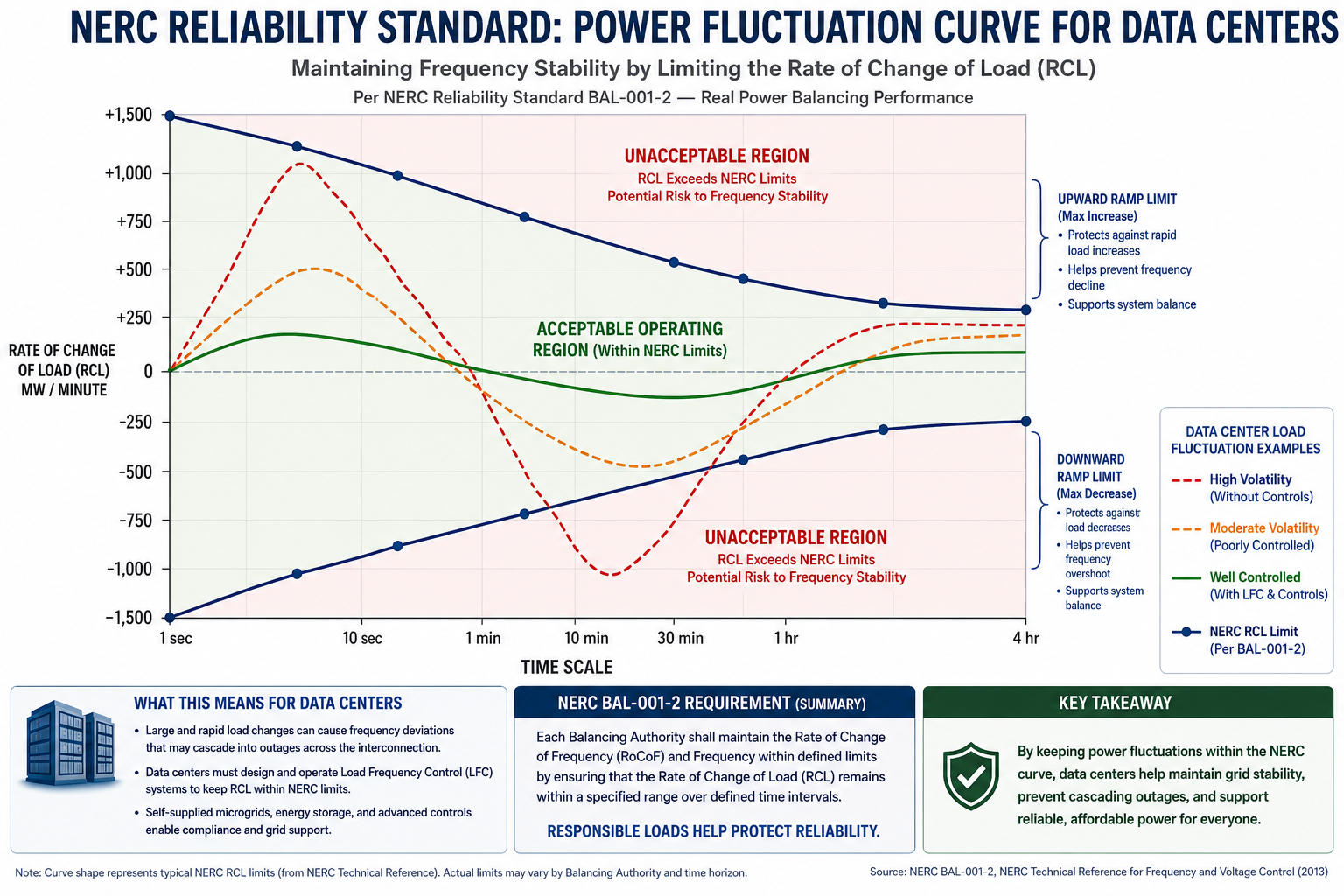
These systems should include:
For facilities with onsite generation, energy storage, or dedicated power resources, the requirement should go further.
They should operate as self-supplied microgrids capable of supporting both:
When connected to the bulk power system, the facility participates in maintaining frequency and reliability rather than simply consuming energy.
During major disturbances, the facility should be capable of separating from the grid and sustaining critical operations independently without imposing additional stress on neighboring customers.
Microgrid technology is mature. Battery systems, gas generation, advanced controls, and inverter-based resources already make this possible.
The question is no longer whether it can be done.
The question is why it is not required.
The traditional model assumes balancing authorities manage generation while loads simply consume.
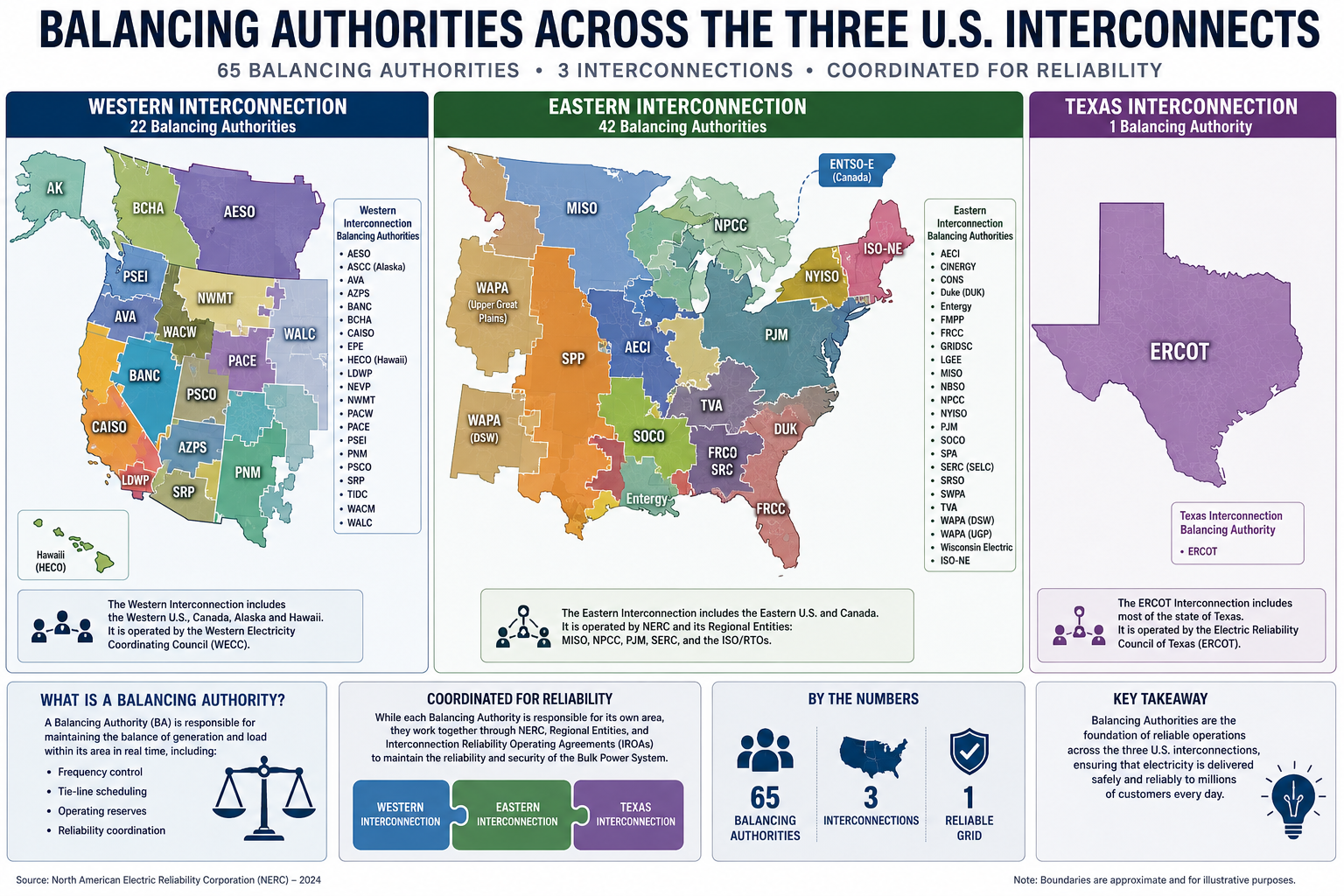
That assumption breaks down when a single customer consumes as much electricity as a metropolitan area.
Large loads should be assigned balancing authority responsibilities proportional to their size and system impact.
This does not necessarily mean creating entirely new balancing authorities, but it does mean establishing:
If a facility's operating decisions can affect neighboring transmission systems, then those neighboring systems deserve visibility and coordination.
The reliability obligations imposed on generation should increasingly apply to loads whose scale rivals generation.
There is another issue that deserves more attention.
Who benefits?
The economic gains from large AI data centers, hyperscale cloud facilities, and similar developments are concentrated among a relatively small group of investors, shareholders, and technology companies.
The reliability costs are not.
Transmission upgrades, additional reserves, generation construction, congestion relief projects, and reliability investments often become socialized across broad groups of ratepayers.
In many cases, families, small businesses, schools, and local communities end up paying higher electric bills to support infrastructure built primarily to serve facilities from which they receive little direct economic benefit.

That raises a fundamental fairness question:
Why should ordinary customers pay for the reliability consequences of private profit centers?
If a project creates incremental reliability costs, reserve requirements, transmission upgrades, or operational complexity, those costs should be assigned directly to the project causing them.
The beneficiaries should bear the burden.
Not the public.
Critics may argue that renewable generation has also imposed integration costs on the grid.
That is true.
But there is an important distinction.
Renewable resources generally create broad public benefits that flow to all consumers:
The reliability costs associated with renewable integration are at least partially offset by system-wide benefits that accrue to all ratepayers.
The same cannot automatically be said for large data center loads.
A residential customer may never use the AI models being trained.
A retiree on a fixed income may never benefit from the cloud services driving the demand growth.
Yet both may face higher electric bills and increased reliability risks if costs are broadly socialized.
The policy treatment should reflect that difference.
The electric grid exists to serve the public.
Its primary purpose is not to maximize the profitability of a handful of large corporations.
If a data center requires dedicated generation, frequency reserves, transmission expansion, inertia substitutes, voltage support, or reliability enhancements, then those costs should be incorporated into the economics of the project.
The era of treating gigawatt-scale loads as passive customers should end.
Large loads should:
Most importantly, the people who depend on the grid for their homes, schools, hospitals, and small businesses should not be forced to subsidize the reliability requirements of private infrastructure built for private gain.
Reliability is not free.
And the people least able to absorb higher electric bills should not be the ones paying the tab.
Some may view balancing authority obligations, load frequency control requirements, and self-supplied microgrids as merely additional costs for large data centers. In reality, they represent an opportunity.
A rapidly growing ecosystem of generator-set manufacturers, battery energy storage providers, inverter suppliers, microgrid integrators, and advanced control system vendors already offers the technologies needed for large loads to become active participants in grid reliability. The equipment exists today to enable data centers to self-balance, provide frequency response, manage reserves, support voltage regulation, and operate seamlessly in both grid-connected and islanded modes.
Rather than viewing these capabilities as regulatory burdens, data center developers should recognize them as strategic assets.
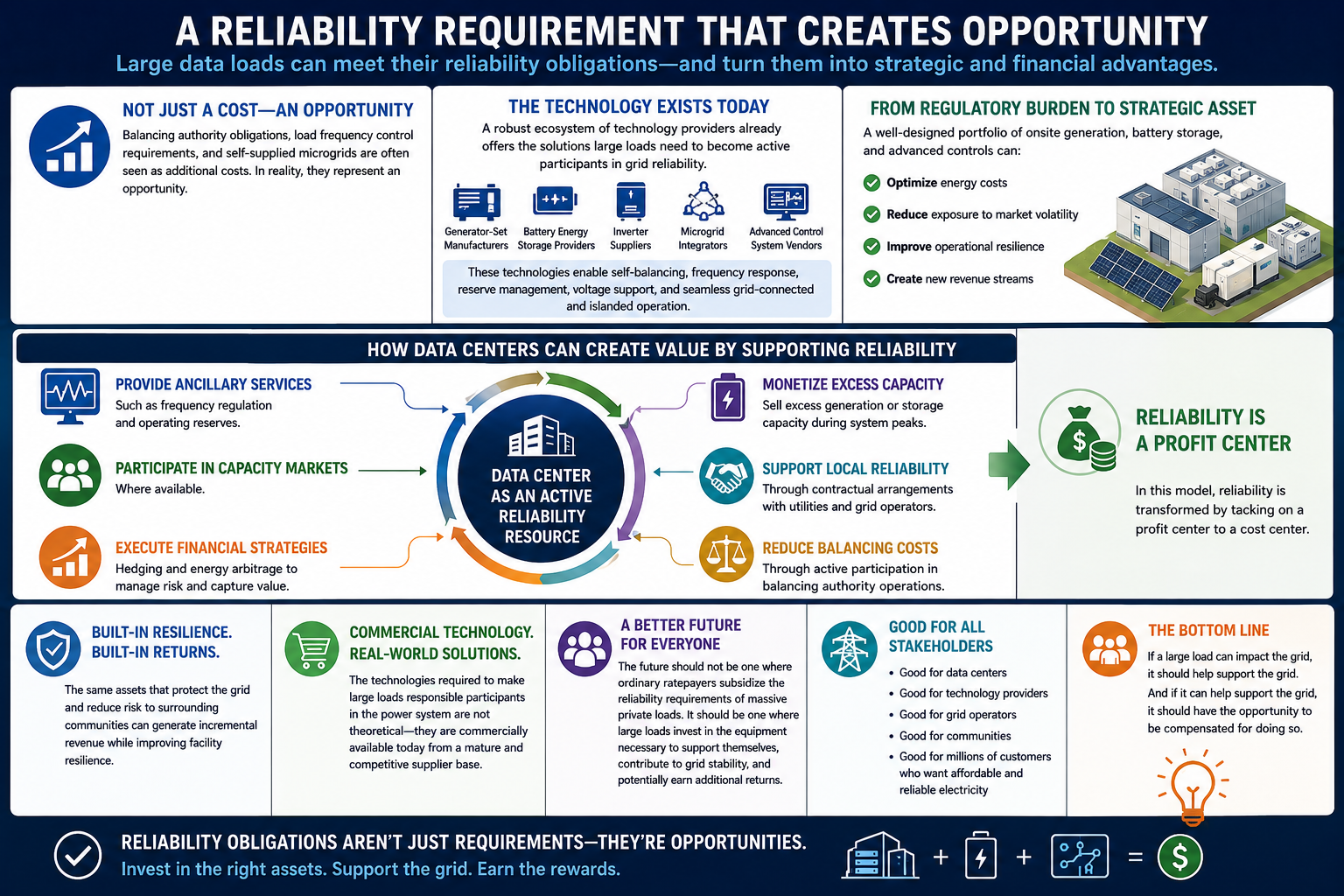
A properly designed portfolio of onsite generation, battery storage, and advanced controls can allow a facility to optimize energy costs, reduce exposure to wholesale market volatility, and improve operational resilience. More importantly, these assets can create entirely new revenue streams.
Data centers equipped with flexible load controls, dispatchable generation, and energy storage can participate in financial and physical power markets by:
In this model, reliability is transformed by tacking on a profit center to a cost center.
The same assets that protect the grid and reduce risk to surrounding communities can generate incremental revenue while improving facility resilience. The technologies required to make large loads responsible participants in the power system are not theoretical—they are commercially available today from a mature and competitive supplier base.
The future should not be one where ordinary ratepayers subsidize the reliability requirements of massive private loads. The future should be one where large loads invest in the equipment necessary to support themselves, contribute to grid stability, and potentially earn additional returns by becoming active reliability resources.
That outcome is good for data centers, good for technology providers, good for grid operators, and most importantly, good for the millions of customers who simply want affordable and reliable electricity.
If a large load can impact the grid, it should help support the grid. And if it can help support the grid, it should have the opportunity to be compensated for doing so.
According to Terry Boston former CEO of PJM Interconnect he contends the DOE report on future reliability has bad news in it of forecasting 800 hrs a year of outages. Can a data center load supply requirements only depend on reliability measures of a public grid? The answer is: should be decided on a case by case basis and in anycase the data center needs to bring reliability measures to the table.
The following info graphic has indicative views of stakeholders.
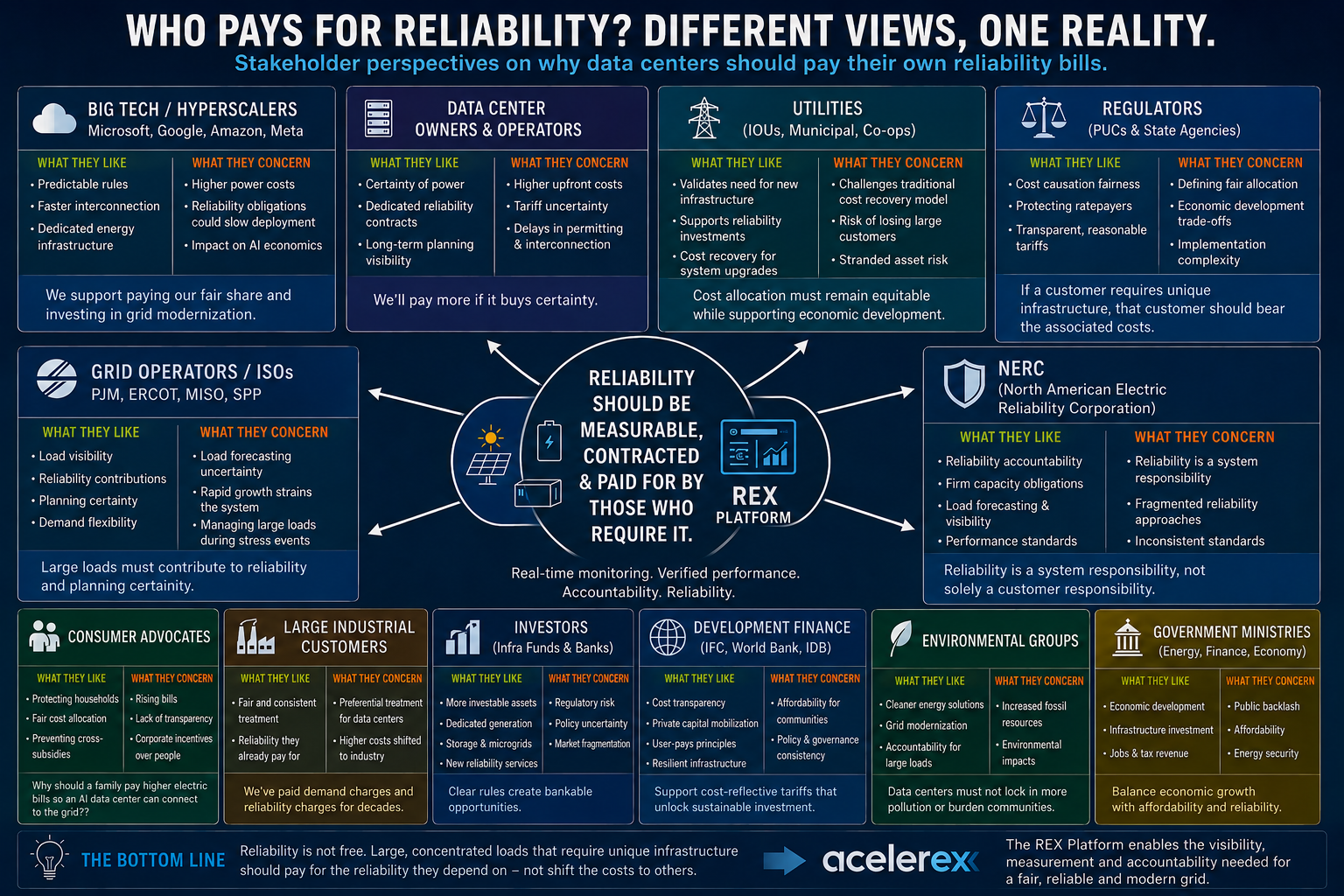
Reliability is not free, but it can create value. The organizations that invest in supporting the grid will be better positioned to manage risk, unlock new opportunities, and help build a more resilient energy future.